
Manual VAPT vs Automated Scanners: What Scanners Miss | BERRY9
Automated vulnerability scanners and manual penetration testing solve different problems. Comparing a scanner subscription price to a manual VAPT quote leads to under-scoped security reviews and missed authorization flaws.
Buying guides · By Thimmagurudu Bathini, CTO · Published · 4 min read
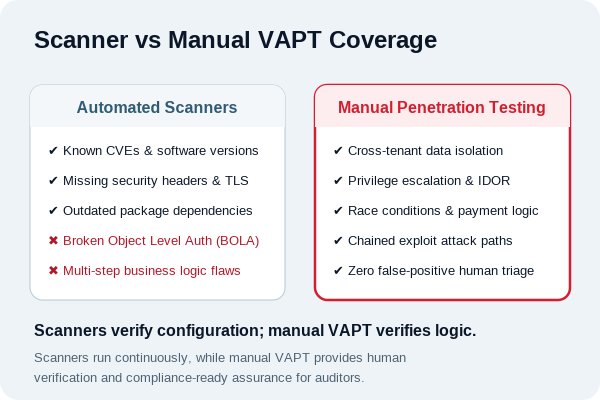
What Automated Scanners Catch Well
Automated scanners excel at checking known CVEs, missing TLS or security headers, exposed administrative panels, and outdated software versions across large IP ranges. Running a scanner continuously helps teams catch configuration drift between major releases.
What Automated Scanners Miss
Scanners cannot understand your application's business rules or user roles. They routinely miss Insecure Direct Object References (IDOR), multi-step workflow bypasses, broken tenant isolation, privilege escalation between customer and admin roles, and chained API logic flaws.
Why Scanner Subscriptions and Manual VAPT Are Priced Differently
A scanner subscription bills for automated crawl capacity, whereas manual VAPT pays for an engineer spending 5–10 working days testing authenticated workflows by hand and writing developer-ready reproduction steps. At BERRY9, small unauthenticated starter scopes begin at ₹9,000 + 18% GST (₹10,620 total), while authenticated web and API assessments start at ₹27,000 + 18% GST (₹31,860 total).
When to Use Each
Use automated scanning for continuous hygiene on public IPs and dependencies. Commission manual VAPT before major releases, customer security questionnaires, SOC 2 or ISO 27001 audits, or whenever users sign in to sensitive data. See our VAPT cost guide or recurring VAPT options for ongoing coverage.