
How to Scope a Web App or API Pentest (and Avoid Surprise Quotes) | BERRY9
Two web applications with the same page count can require very different testing effort. Knowing which details drive scope helps you get an accurate quote on the first call.
Buying guides · By Thimmagurudu Bathini, CTO · Published · 4 min read
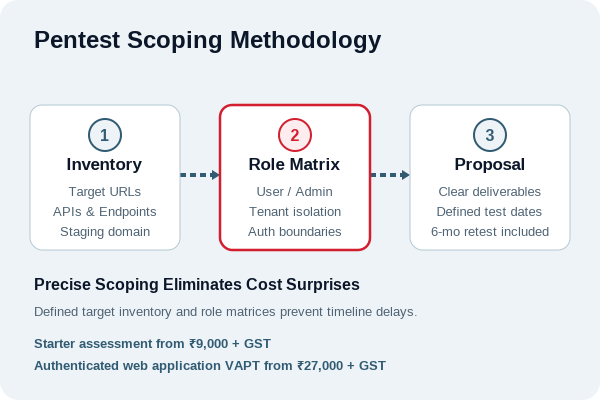
Starter Scope vs. Authenticated Application
A small starter assessment (from ₹9,000 + 18% GST, or ₹10,620 total) applies only to a simple unauthenticated website such as a basic WordPress site or 3–5 external IP addresses. Once users sign in with roles, workflows, or APIs, the engagement is an authenticated assessment starting from ₹27,000 + 18% GST (₹31,860 total).
Five Inputs That Set Testing Days and Cost
| Scoping factor | What to share in your brief | Why it matters |
|---|---|---|
| User roles | Number of distinct roles (e.g., guest, customer, support, admin) | Each role boundary must be tested for horizontal and vertical access control flaws. |
| Endpoints & workflows | Approximate endpoint count, OpenAPI/Postman files, and key multi-step flows | Complex checkout, approval, and tenant-switching flows require manual logic testing. |
| Environments | Staging URL, test accounts, and IP allowlisting | Dedicated staging avoids production disruption and lets engineers test destructive payloads safely. |
| Compliance target | Whether the report goes to SOC 2, ISO 27001, PCI DSS, or a customer | Determines report evidence format and whether a CERT-In empanelled auditor is required. |
| Timeline | Target report date and retest window | Most authenticated tests take 5–10 working days once access is active. |
What Starts the Testing Clock
Before testing starts, BERRY9 needs target URLs, working test credentials for every in-scope role, and a signed scope memo. The 5–10 working-day schedule begins once all three are in place, and critical findings are flagged during testing before the final report is issued.